Bloomwood Stories: Block Party

Impact: Shipped a health game for the National Library of Medicine, exhibited at the Harlem Museum of Science; the quest response framework I developed was adopted by another game project.
Recognition: Best Student Game (Meaningful Play 2022), Finalist for the James Paul Gee Learning Game Award (2021), and design findings published at CHI 2021.
Research: A randomized experiment (38 players, 5 cities) and a follow-up qualitative study found that connecting with characters predicted lasting gains in health self-efficacy, and 7 of 8 players expanded how they saw their health support networks.
Role & timeline: Lead Researcher, Game Designer, Narrative Designer, Producer; 25-person team; Sept 2020 – Jan 2026
Overview
Bloomwood Stories: Block Party is a single-player visual novel game designed to empower members of historically marginalized communities to improve their health knowledge and self-efficacy. The player takes the role of a trusted community advocate who helps their neighbors solve health-related problems before the Block Party at the end of the week.
Role: Lead Researcher, Producer, Game Designer, Narrative Designer
Duration: Sept 2020 - Jan 2026
Team: Morgan C. Evans, Adela Kapuścińska, Gal Flessig, Eleanor Hofstedt, Maya Greenholt, Yang Lei, Junchao (David) Lin, Xuanyuan (Ember) Liu, Jaclyn Saik, Meo Zhang
Tools: Figma, twine
Client: National Institutes of Health, National Library of Medicine
The Design Challenge
Members of historically marginalized communities face significant barriers to formal healthcare, from racial bias in pain medication prescriptions, to undocumented individuals who cannot access insurance. Changing these systems is slow. We looked to informal health resources as a complementary approach.
The design challenge was: how do you use a game to introduce people to informal health resources and build their confidence to use them?
My Role
I wore many hats on this project. My specific contributions were:
Conducted and synthesized a literature review to align game content with funders' goals
Used affinity diagramming to identify categories of educational content from an existing board game
Ran focus groups with the target population to inform character design and narrative
Defined the role of the player character and their relationship to NPCs
Designed the conversation framework and solve-quest interface
Designed and wrote the entire character Mrs. Lee
Produced the project during production, keeping the team on track and within scope
Ran a quantitative study post-release measuring the game's impact on health self-efficacy
Ran a qualitative study with podmaps to understand how players perceived their community resources
Designing the Player Character
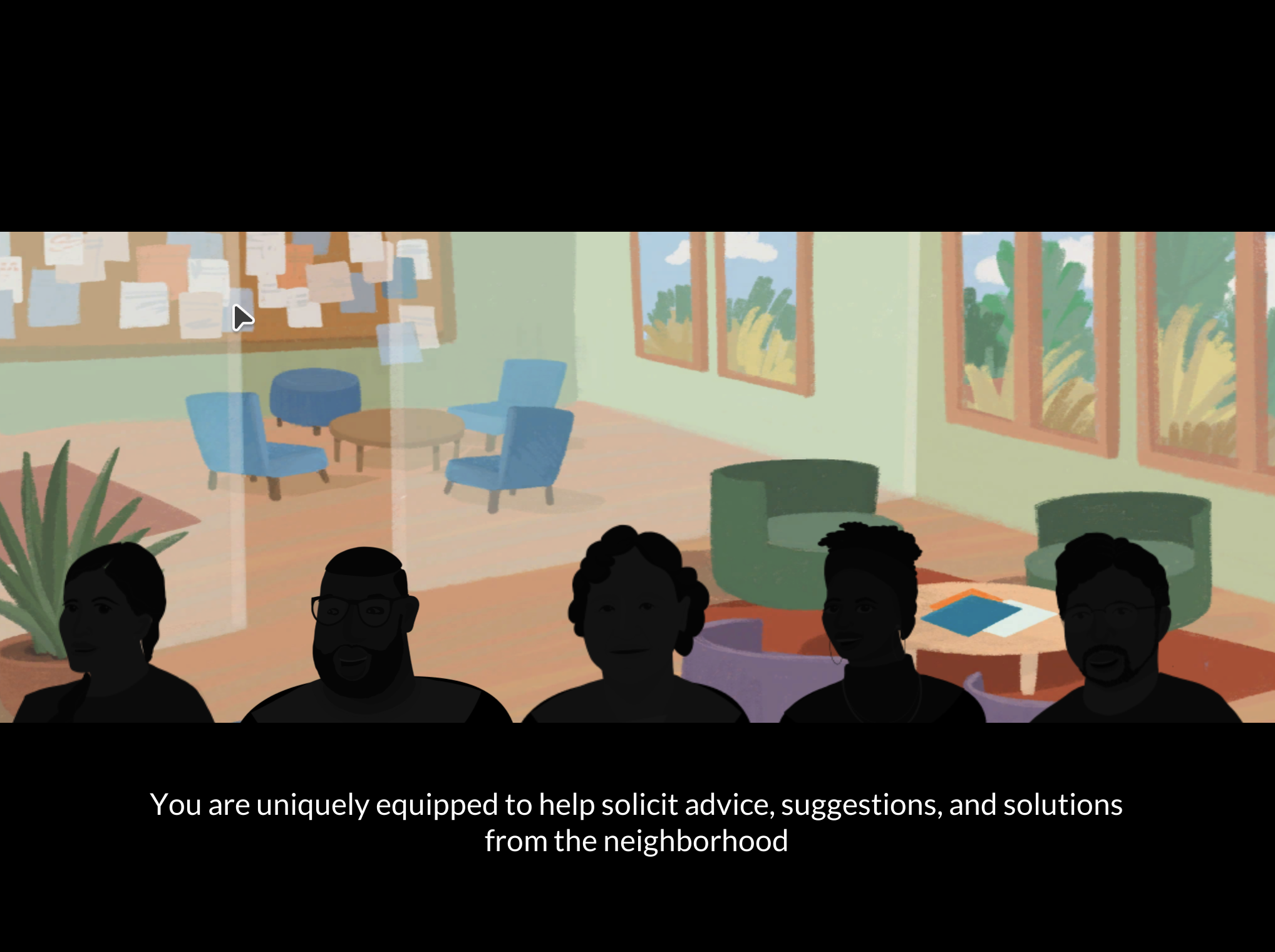
One of the most important design decisions in Bloomwood was the player character. We made four deliberate choices.
The PC has no avatar. The game's intended audience is broadly defined as members of historically marginalized communities, which encompasses many identities, backgrounds, and lived experiences. By omitting an avatar, we gave players space to project themselves into the role rather than identifying with a specific character.
The PC is a community member, not an outsider. This allowed us to write relationships between the PC and NPCs from an already trusted position, which was helpful when some of the topics were sensitive or personal.
The PC has an acknowledged role as community advocate. This gave the player a purpose for roaming between community establishments and connecting information from different neighbors, making the gameplay feel intentional rather than arbitrary.
The PC is not a health expert. The player learns alongside the PC. Any time the PC learns the correct answer is the right time for the player to learn it too. We did not want players who already had low health knowledge to feel inadequate.
Our qualitative research later validated these choices. Players described the PC role as feeling natural and intuitive. One participant said it felt like "just doing what I do in real life," while another described "confusing the community advocate with the grandson" because the relationship to Mrs. Lee felt so familiar from their own life.
Designing the Non-Player Characters
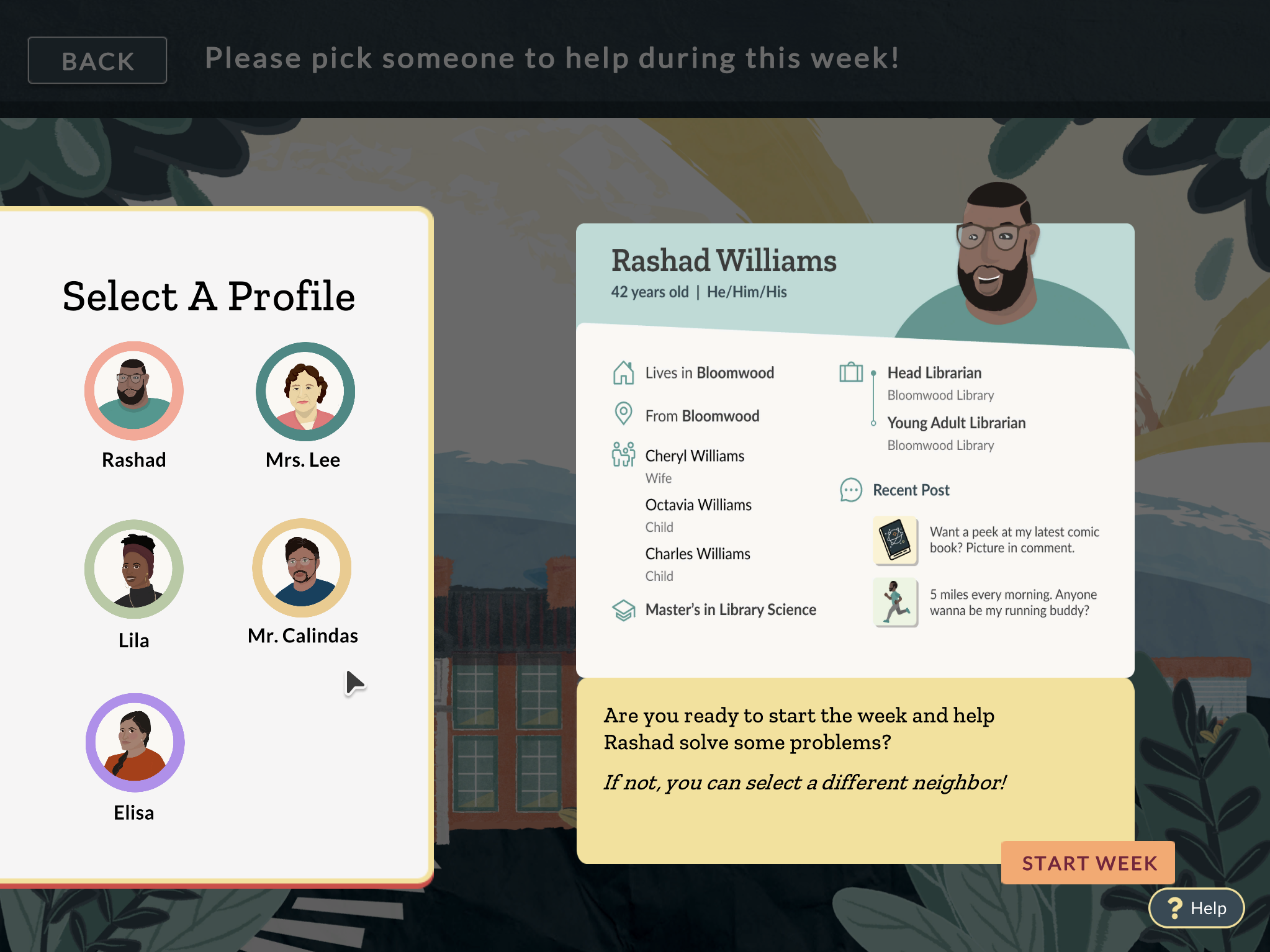
We designed five NPCs to achieve sufficient coverage of health topics from the original board game. Each NPC has four quests, which are health-related problems they face that the PC helps them solve by gathering information from other community members.
Each NPC faces more than one issue. We designed realistic narrative arcs rather than single-issue characters, so players engaged with the full complexity of each person's life.
Each NPC has insights to contribute. NPCs are not just recipients of help. They are also sources of expertise for other characters' quests, which directly challenged the deficit model of representing marginalized communities.
Avoiding the deficit model. We gave each NPC multiple overlapping identities, some marginalized and some dominant, to show that anyone can face health challenges and anyone can offer help. For example, Rashad is Black and a man. Giancarlo is a first-generation immigrant and a Head Nurse. By the time players start helping a second character, they see their first NPC show up in a powerful new role.
Designing Mrs. Lee
Mrs. Lee is the character I am most proud of in my career. She is a Korean-American grandmother with low health self-efficacy, anxious, caring deeply about her family over herself, and navigating the healthcare system in her second language. I based her on my own grandmother, for whom I was the primary caretaker throughout my PhD.
I researched the structural differences between Korean and American English sentence patterns and embedded them into her speech. Mrs. Lee's grasp on grammar shifts depending on her emotional state. When she is calm her sentences are more traditionally correct, and when she is upset or in pain her sentence structure loosens.
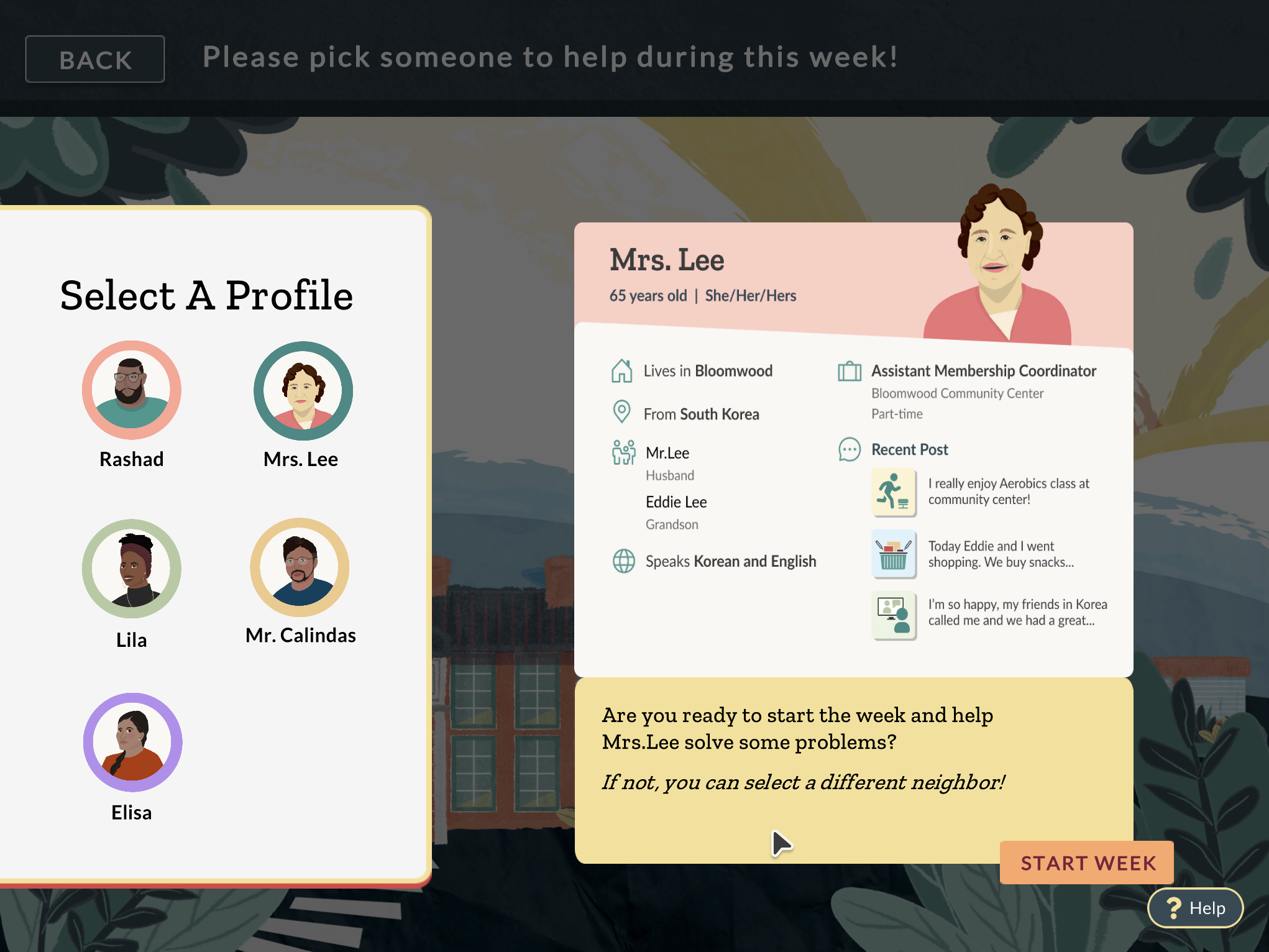
When our DEI reviewers flagged her language as potentially stereotypical, my team and I interpreted this as a mismatch between the reviewers' lived experiences and those of the game's intended audience. To address it, we formalized the linguistic rules behind Mrs. Lee's speech and reduced her deviations from formal English grammar, while preserving who she was. In retrospect, we could have also communicated our design choices to players directly, for example by explaining in a character summary screen that Mrs. Lee's English changes when she becomes activated or upset.
The Solve-Quest Interface

The solve-quest interface is where players return to Mrs. Lee and attempt to help her solve a health problem using information they have gathered from other community members.
In our first version, quest answers were simply correct or incorrect. During playtesting we found this was not enough. If a player got a wrong answer, we had no way of knowing whether they had not absorbed the information or whether they were struggling to apply it to Mrs. Lee's specific situation.
We redesigned the interface around a context and domain framework. A correct answer had to satisfy two conditions: accurate health information (domain) AND something actionable for Mrs. Lee specifically given her circumstances (context). For example, "Mrs. Lee can ask Lila to pick up the prescription" satisfies domain but not context. It does not help Mrs. Lee learn to advocate for herself. "Mrs. Lee can take Lila to the pharmacy to help her ask clarifying questions" satisfies both.
This redesign gave us a richer picture of player comprehension and allowed us to design partially correct answers that revealed whether players understood the character's context, the health domain, or both.
The In-Game Dictionary


One of the most distinctive features of Bloomwood is the in-game dictionary, a glossary of over 200 terms including everyday phrases like "out of pocket" and "insurance," as well as medical terminology.
This feature emerged from our DEI review process. Reviewers flagged places where idioms and localized language could create barriers for players unfamiliar with certain expressions. Rather than simply rewording everything, we built a system where players could look up any highlighted term in the game.
The goal was to make sure players never felt talked down to. One of our qualitative study participants later said they "didn't feel dumb for not knowing certain stuff" because the dictionary was there. That was exactly the outcome we designed for.
Research Study 1: The Role of Player Effort on Health Self-Efficacy
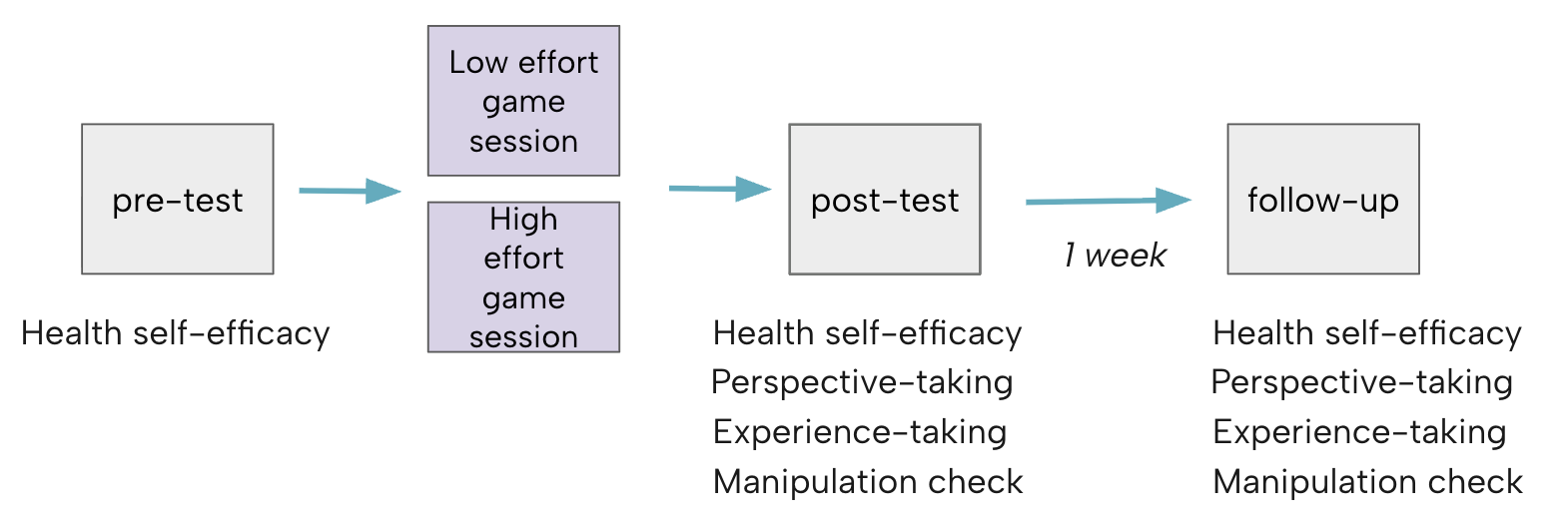
After launch I ran a quantitative study with 38 participants to explore the relationship between perspective-taking effort and health self-efficacy. I recruited participants from Detroit, MI; Baltimore, MD; Memphis, TN; Fort Worth, TX; and Daly City, CA, cities selected for their high proportions of Hispanic, Black, and Asian populations, reflecting our target audience.
I created two versions of the solve-quest interface that varied the amount of effort required from players to consider Mrs. Lee's point of view when offering her advice. In the high effort version, players were required to answer questions analyzing each possible quest solution from Mrs. Lee's perspective before making a selection. In the low effort version, players were presented with the same questions but the answers were pre-filled.
While we did not find significant differences between the two conditions, we did find that players who reported putting more effort into understanding Mrs. Lee's perspective experienced significant increases in health self-efficacy at post-test. Players who more deeply embodied Mrs. Lee's experience through experience-taking showed increases that persisted at a one-week follow-up.
One explanation is that the act of putting in effort is what drives the self-efficacy change. Players who invested effort in the game saw that they successfully helped the character, and as a result may have felt more equipped to handle their own health challenges. This suggests that designing for intrinsic engagement with a character's perspective may be more powerful than any specific mechanical intervention.
Research Study 2: How Players Perceive Community Resources

In a follow-up qualitative study with 8 participants, I used podmaps, a tool originally developed for identifying support networks among people who have experienced harm, to understand how playing Bloomwood affected players' perceptions of their community health resources.
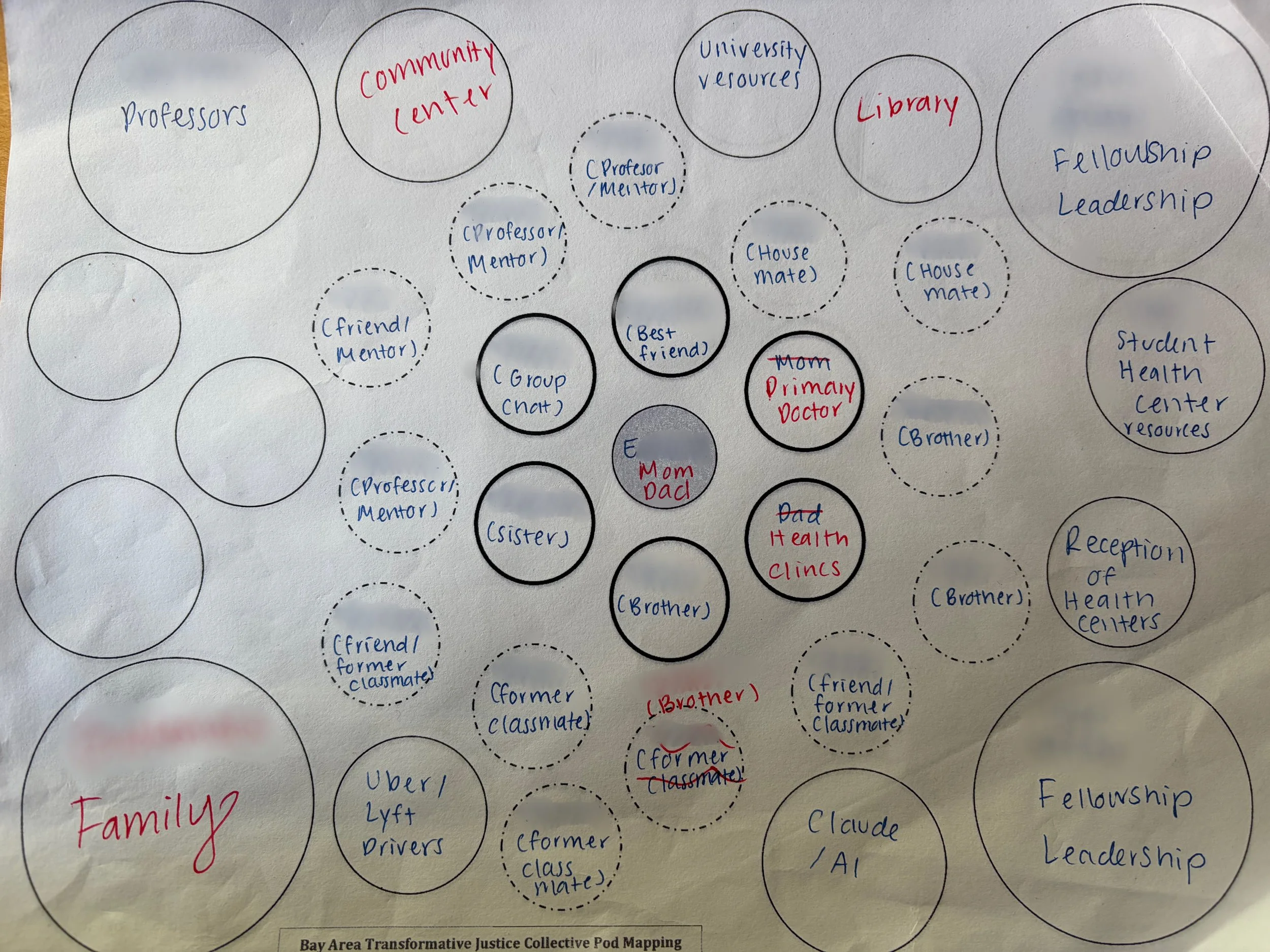
Before playing, participants' podmaps showed tight personal networks centered around family and close friends. Formal health resources were largely absent or placed in the outermost layer.
After playing, 7 out of 8 participants made changes to their maps. Four added health resources they had not previously considered. One participant moved his parents to the very center of his map, placing their names beside his own, reframing health as a collective relational endeavor rather than an individual one. Another moved Reddit threads from the outer resource layer into their inner pod, recognizing community-generated knowledge as a trusted form of support.
Players also reflected on systemic issues, connecting Mrs. Lee's challenges to broader healthcare inequities and asking questions like: "How are we setting up our communities so that these people have access to what they need?"
The design implication is that single-player games can shift how players perceive their real-world support networks. Designing characters with layered, realistic narratives and giving players the tools to connect those narratives to their own lives can expand how players understand community and their own capacity to navigate health challenges.
Reflection
Bloomwood taught me that designing for marginalized communities means designing with them, not just as research participants, but as the evaluative authority on whether your design is honest. Mrs. Lee taught me that authentic representation requires specificity and the willingness to sit with the discomfort of being misunderstood. The podmaps taught me that games can do something I had not fully anticipated: they can help players see their own communities differently. That is the kind of impact I want every project I work on to have.
