INTENT
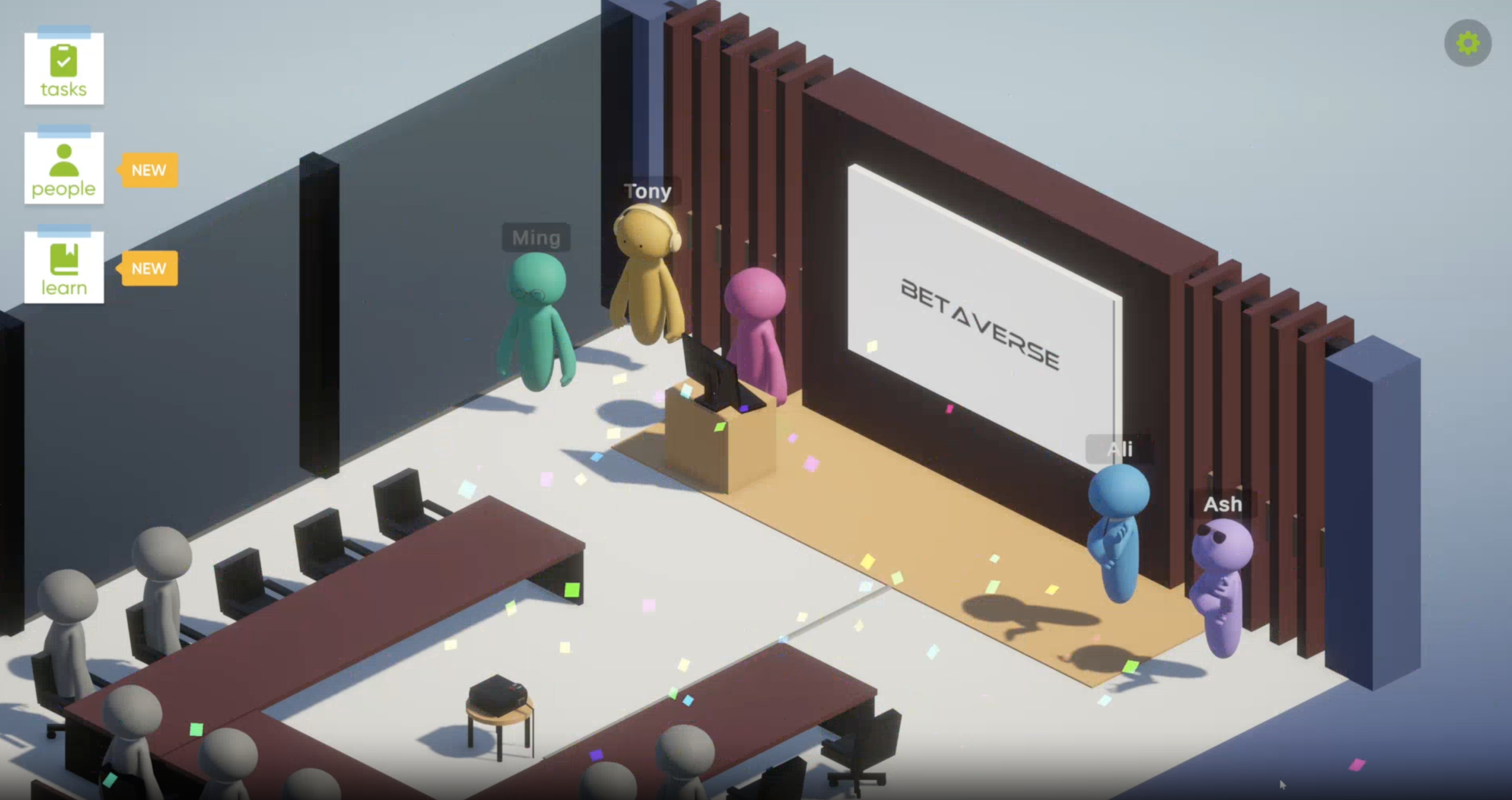
Impact: Shipped a 20-minute web game for the University of Maryland that teaches non-autistic employees to support autistic colleagues through four workplace scenarios drawn from interviews with autistic people.
Recognition: Best Demo Award (Joint Conference on Serious Games 2024; I ran the demo!) and a Silver Medal (International Serious Play Awards 2024).
Research: Think-aloud sessions and interviews with 20 autistic participants confirmed the characters felt authentic across cognitive, emotional, and social dimensions, and led to three design recommendations, including introducing the less stereotypical character first.
Role & timeline: Lead Researcher, Game Designer, Narrative Designer; mentored a 5-person student team; Jun 2023 – Present
Play INTENT Read the paperOverview
INTENT: Interactive Tool for Empathy in NeuroTypicals is a single-player workplace simulation game designed to help allistic players build empathy and allyship towards their autistic colleagues.
The player takes the role of a Team Lead at Betaverse, a fictional tech company, navigating their workday through four workplace scenarios that escalate from basic awareness to active allyship.
The game takes about 20 minutes to complete and was built in Unity for WebGL deployment.
Role: Lead Researcher, Game Designer, Narrative Designer
Duration: June 2023 - Present
Tools: Figma, twine
Team: Morgan C. Evans, Varun Girdhar, Chao-Yang Tseng, Shiyu Wang, Ruoxi Yang, Zibo Ye
Client: University of Maryland
Design Challenge
My role on this project started with a question that arose from designing Bloomwood Stories: how do you authentically represent lived experience when the player is not a member of the affected group?
In Bloomwood, I designed for insiders, players who were members of the communities represented in the game. INTENT flipped that, where the target player is allistic, meaning the game had to teach empathy without reproducing stereotypes or further marginalizing the autistic individuals it sought to represent.
My Role
I was the bridge between research and design on this project. Specifically I:
Collaborated with subject matter experts to establish the research foundation
Mentored a 5-person student team through weekly feedback sessions
Edited all character dialog for voice consistency, tone, and research accuracy
Collaborated on designing the Learning Panel system
Conducted a qualitative study with 20 autistic participants post-launch
Designing the Characters
All characters in INTENT are intentionally humanoid and abstract. They are designed without specific identity markers so players from any background can see themselves in the world. This was a deliberate choice to help players feel connected to the experience without projecting specific identity assumptions onto any character. However, these characters needed the ability to express facial expressions and gestures.
The Player Character
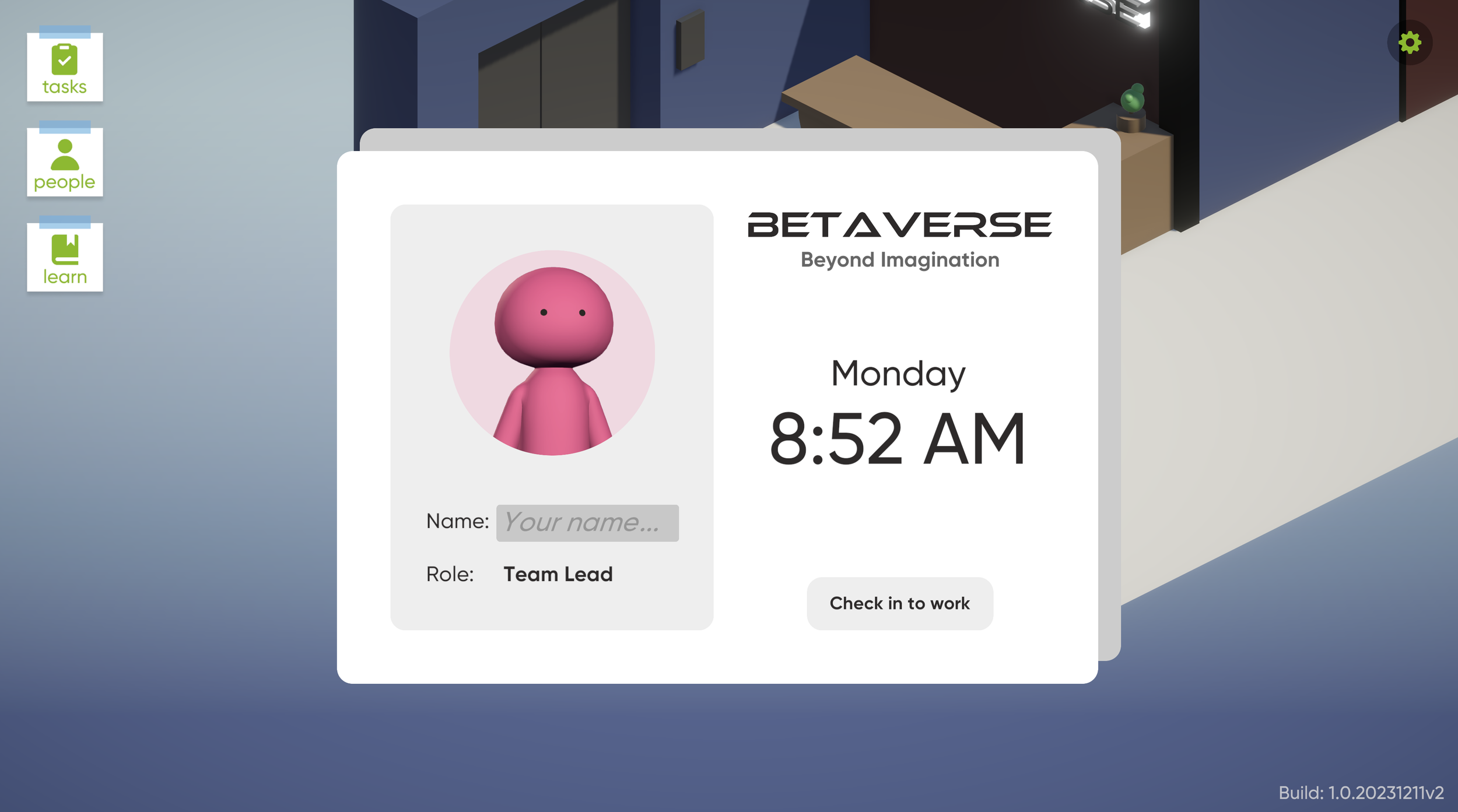
The player takes the role of Team Lead and enters their own name before starting, a small interaction that creates immediate personal investment. The PC also has an internal thought bubble that differentiates private reactions from spoken dialogue, giving players a moment to notice their own instinctive responses before deciding how to act.
The Non-Player Characters
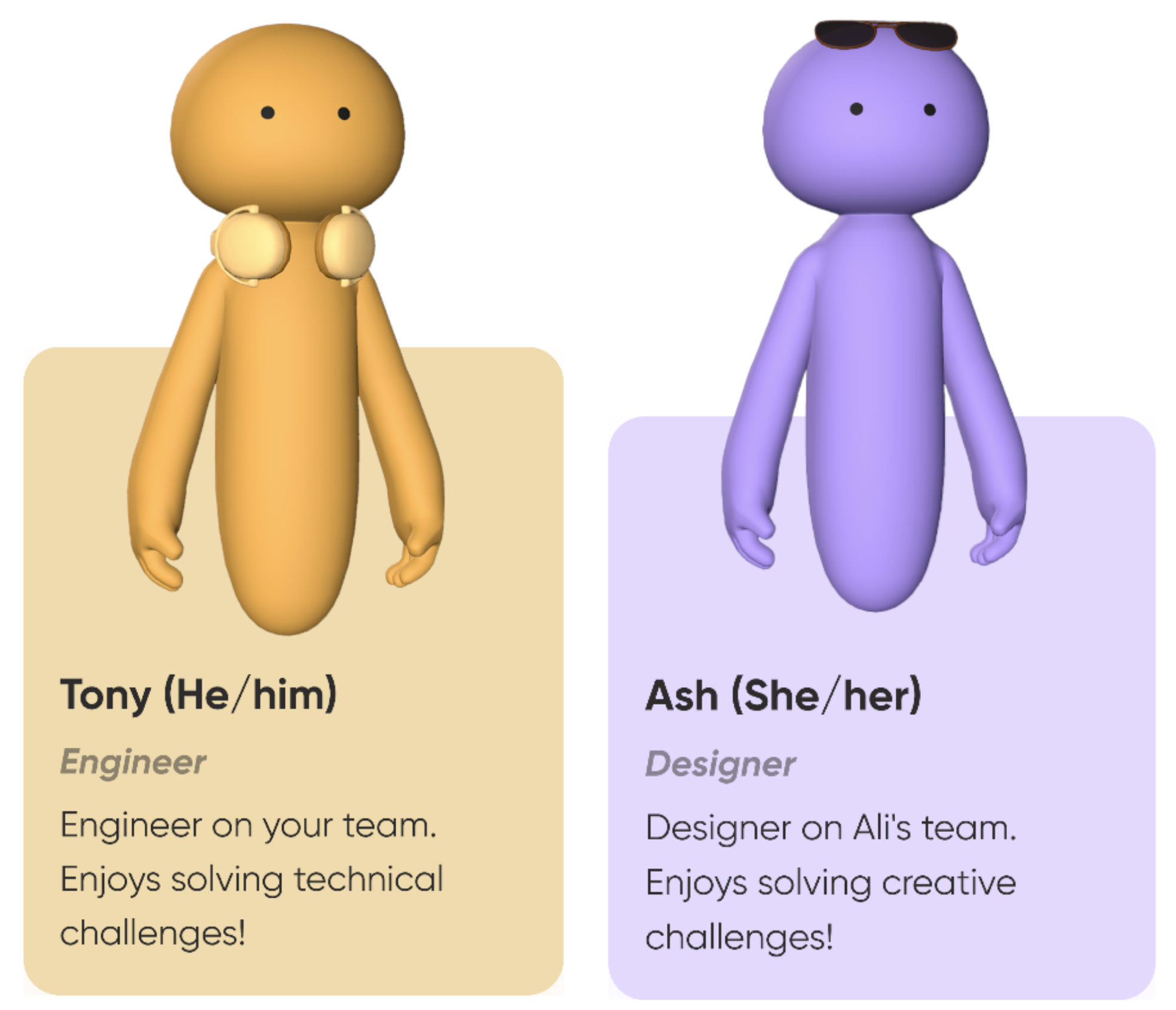
The four NPCs are Tony and Ash, who are autistic, and Ming and Ali, who are allistic. Designing two distinct autistic characters was a research-backed decision.
Tony experiences auditory sensitivity and Ash experiences light sensitivity, representing two different points on the spectrum so players encounter autism as variation rather than a fixed set of traits.
We were also intentional about Tony and Ash's professional competence: Tony leads technical discussions, and Ash holds a creative public-facing role, deliberately challenging stereotypes about autistic professionals.
Narrative Design
The game is a visual novel with branching dialogue determined by player choices at key decision points. I edited character dialog across the game for voice consistency, tone, and research accuracy.
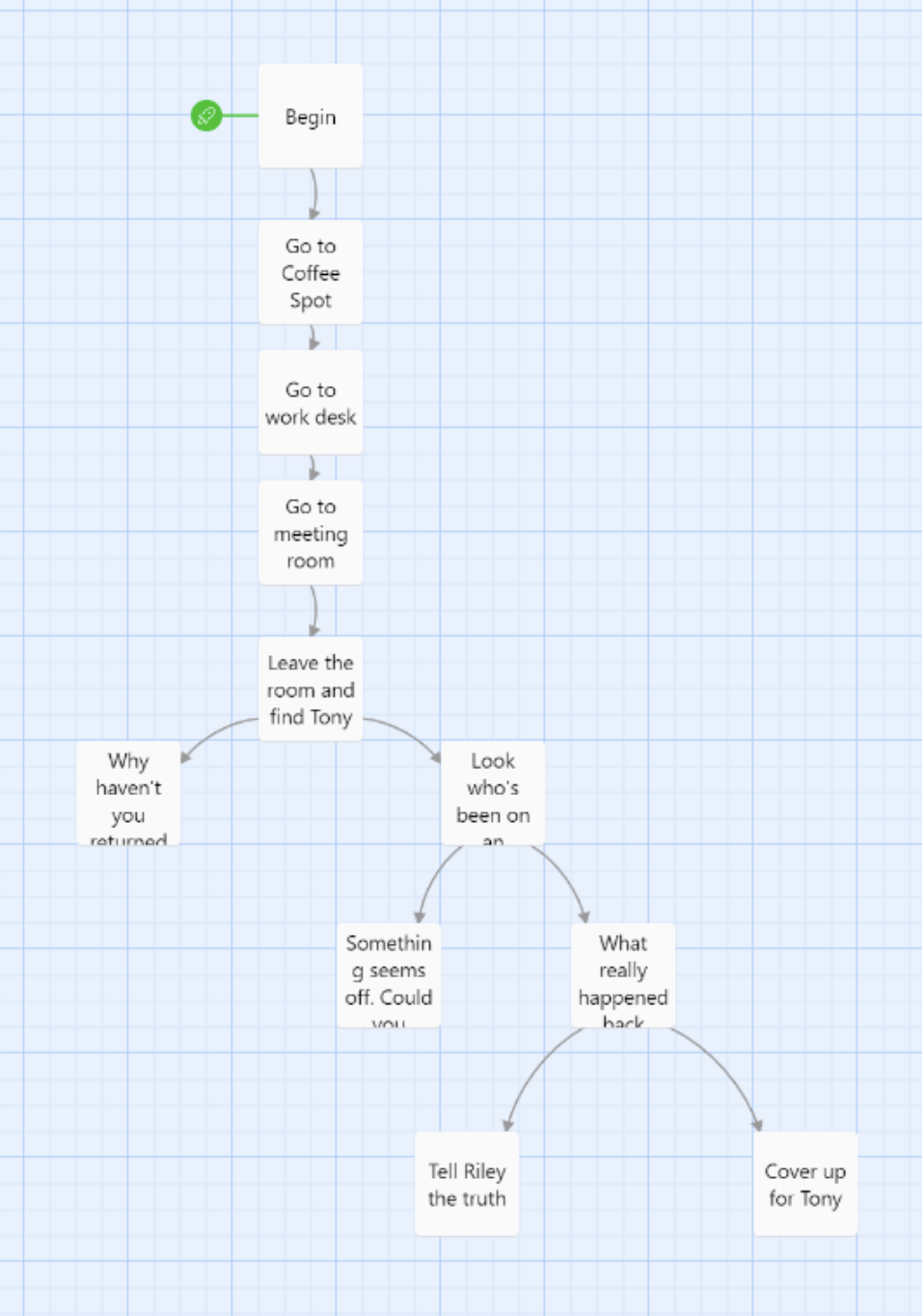
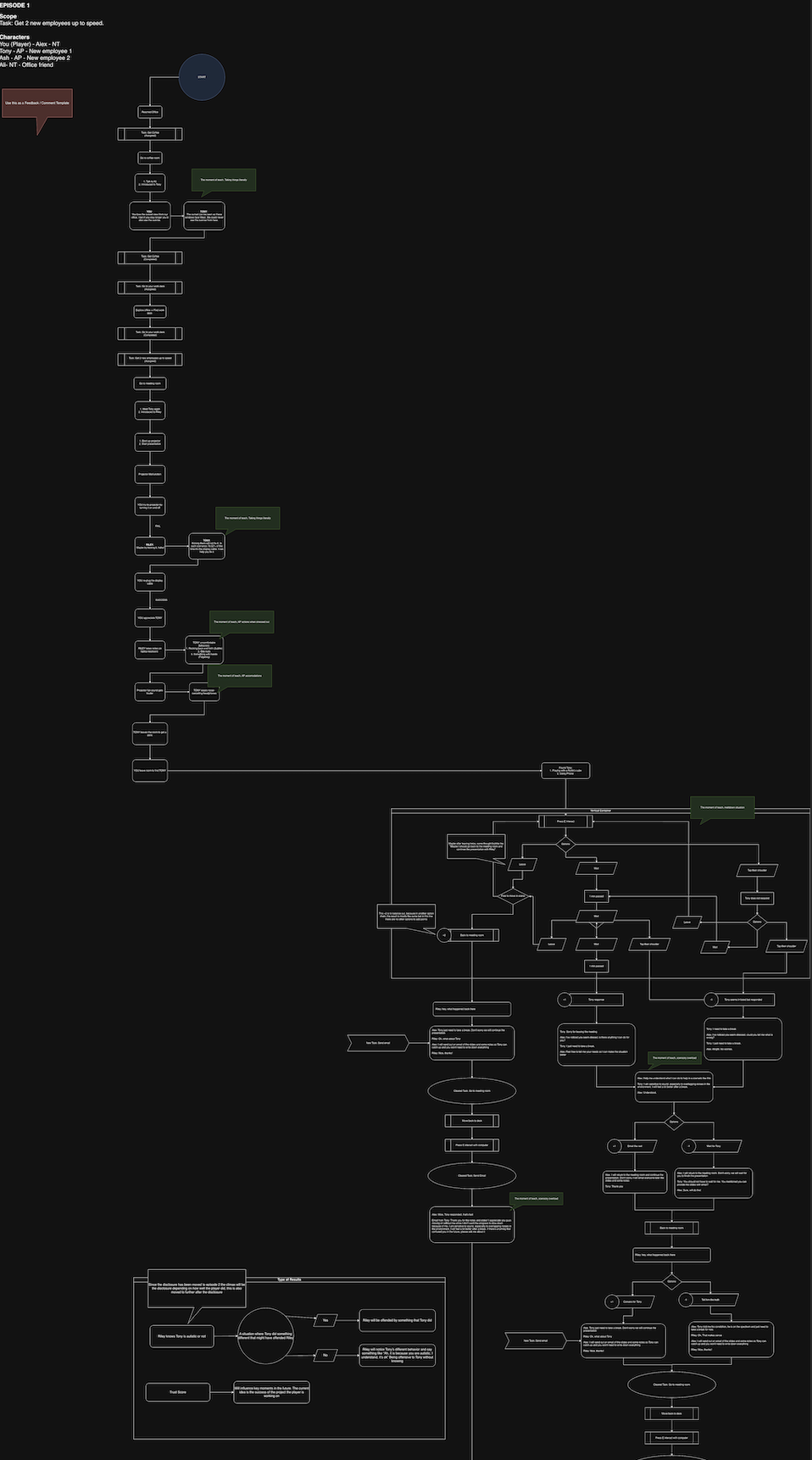
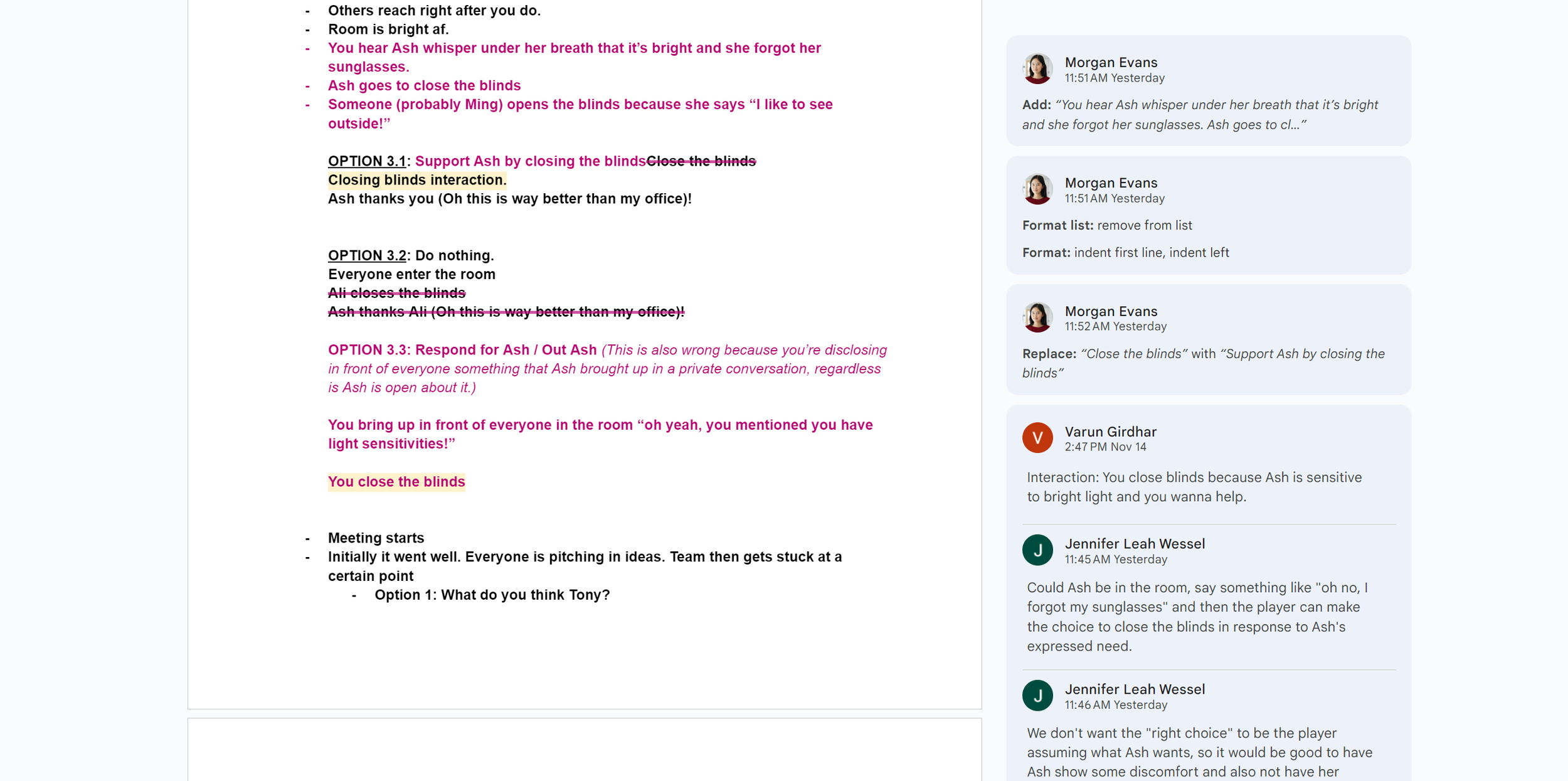
One of the most important narrative decisions I made was around how wrong answers are designed. Early in the game none of the dialogue options are ideal and this is intentional. The game's pedagogical premise is that learning emerges through imperfect practice. Players need to experience the discomfort of not knowing the right answer before they can recognize more inclusive behaviors later.
Four Scenarios
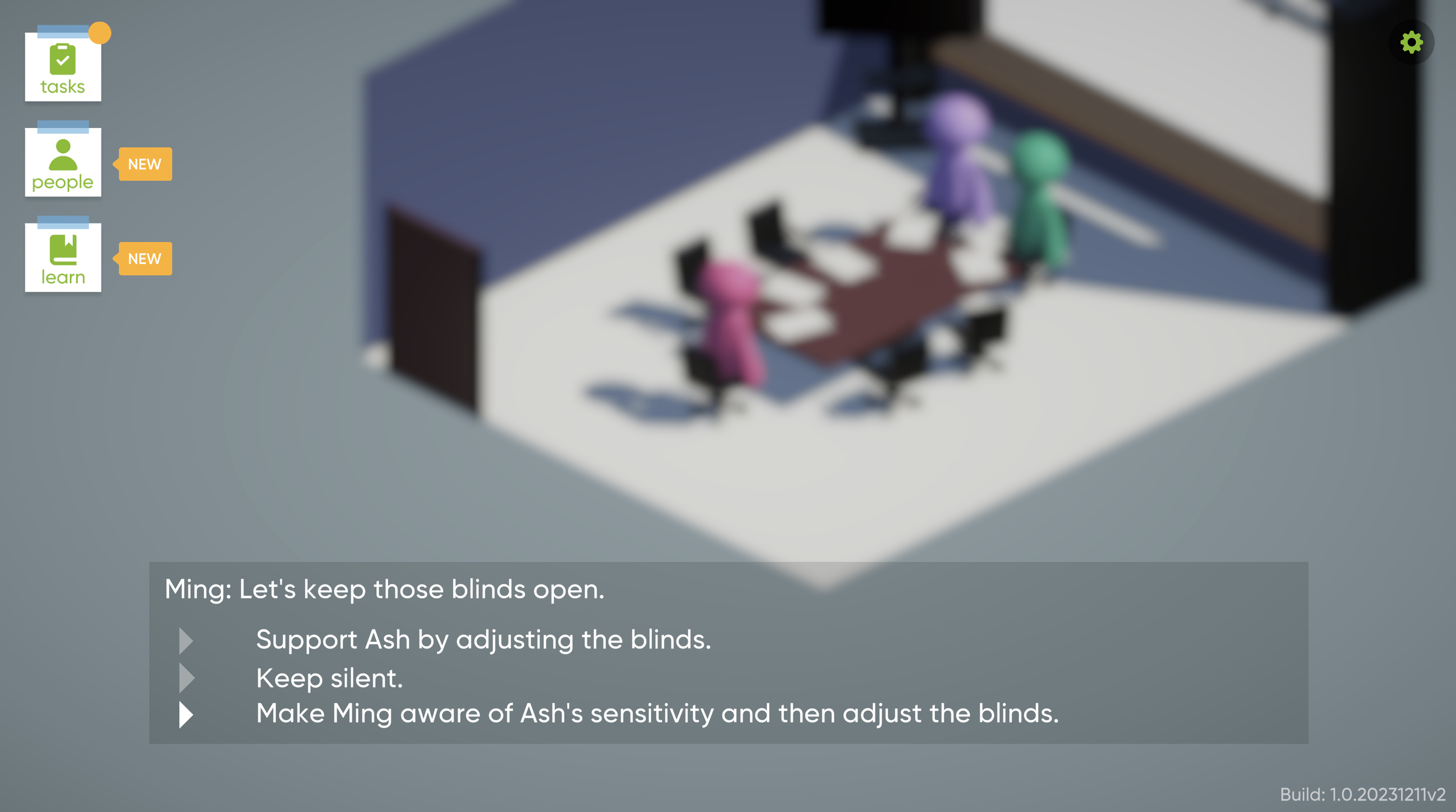
The narrative is built around four workplace scenarios developed from interviews with autistic individuals:
Scenario 1: A Different Communication Style Tony takes a sarcastic joke literally. None of the available responses are ideal which is setting up the player's learning journey.
Scenario 2: Sensory Overload A noisy projector causes Tony visible distress. The player must decide whether to support his need for space or pressure him to stay.
Scenario 3: Respecting Privacy Ash discloses her light sensitivity privately. When a colleague reopens the blinds, the player must decide how to respond, including whether to disclose Ash's sensitivity without her consent.
Scenario 4: Collaborative Problem-Solving Tony is assigned a vague new project that overwhelms him. The best outcome emerges when the player creates space for Tony to share his own framework modeling inclusive leadership as empowerment.
Learning Panel
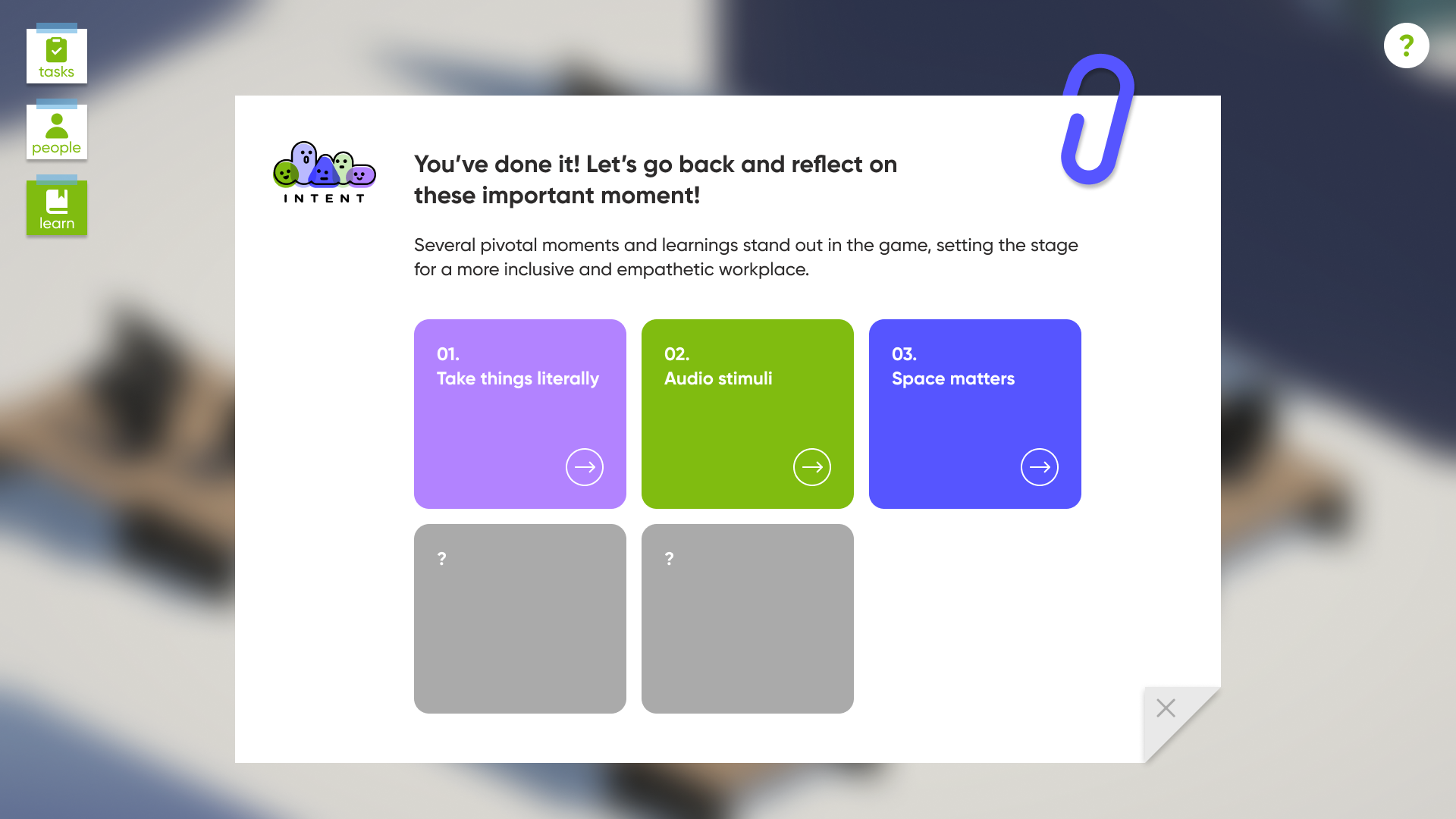
The learning panel is a sidebar that surfaces lessons as players progress through each scenario. Each lesson is tied to a specific scene, allowing players to reflect on their choices in context. If a player made a suboptimal choice, the panel offers a suggestion without being punitive.
This system was grounded in a core research principle: reflection after play deepens learning. The Learning Panel gives players a structured moment to connect their in-game choices to real workplace behavior.
Research: Autistic Players’ Perspectives
After the game shipped a research assistant and I conducted a qualitative study with 20 autistic participants to evaluate the authenticity of the representation. Each session included a think-aloud gameplay session followed by a semi-structured interview. We developed a collaborative codebook with a research assistant, coding transcripts independently before reconciling to ensure reliability.
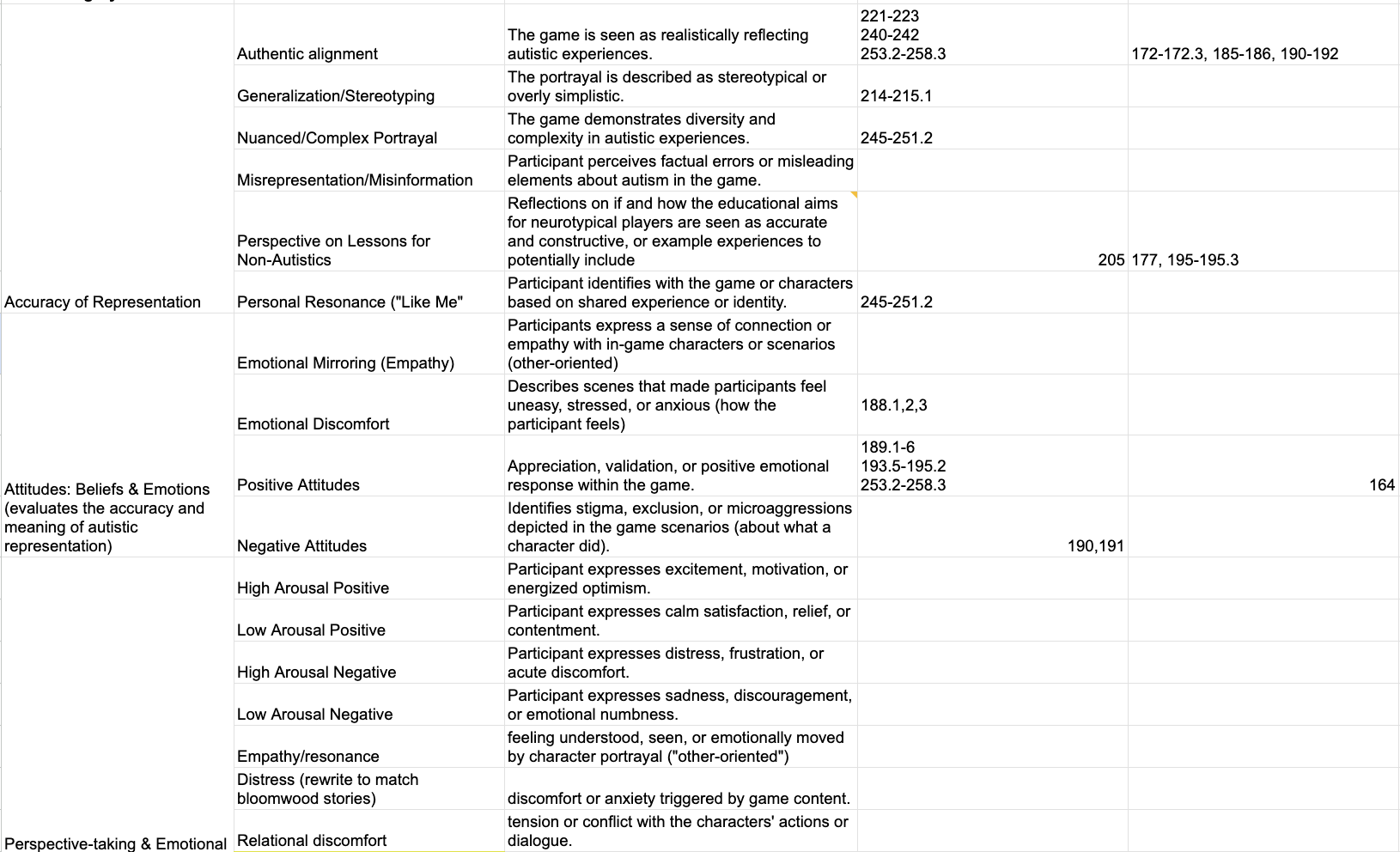
What we found:
RQ1: How do autistic players relate to autistic characters? Participants identified cognitive, emotional, and social resonances with Tony and Ash. They also appreciated seeing autism represented as a spectrum across two distinct characters.
RQ2: How do players anticipate the allistic response? Participants raised concerns about stereotype risk early in the game, before Ash is introduced as a contrasting character. They also questioned whether allistic players would see the lessons as relevant to their own role.
RQ3: What lessons do autistic players see? Participants identified environmental, interpersonal, and structural lessons from designing flexible physical spaces to addressing workload distribution as a systemic allyship practice.
Design Recommendations:
Based on the research findings I identified three recommendations for future iterations:
Introduce the less stereotypical autistic character first to give allistic players a more flexible schema before encountering behaviors they might overgeneralize
Expand the player character's role beyond team lead so allistic players see the lessons as relevant regardless of seniority
Develop additional structural scenarios that address organizational factors like workload distribution and role clarity
Reflection:
Designing INTENT taught me that authentic representation requires bringing the community you're designing for into the process, not just as research subjects, but as evaluative authorities on whether the design achieves its goals. The most valuable insights I gathered weren't from design decisions I made, but from listening to autistic players describe what it felt like to finally see themselves represented accurately at work.